Category: Travel

  • Media versus reality

    As the Aeromexico flight we’re on crosses the US-Mexican border I can feel a tangible change. Up until this invisible line there has been no deviation from a flight path: an arc out of Montreal and then a diagonal line towards Houston. As we cross the border flight attendants wheel a cart down the aisle full of free tequila and fruit juices and in the cockpit the captain curves the plane to the west just south of Matamoros and sets a long, straight bead on the Mexico City airport. It’s a busy airport but we’re not waiting for anyone. He barrels in straight, slapping down at a lot faster than usual and then coming up short after a strong brake. You get a definite impression that he feels this is his place, and so too do our two-hundred or so co-passengers. A few whitish faces to be seen, but most people are coming home, in one sense or another.

    Crossing mountains north of Mexico City
    Crossing mountains north of Mexico City It’s hard to believe that there could be a village or agricultural land in such a landscape, but you can see both in the river bed near the bend.

    I have a friend who lives in Europe who wrote a few days ago to confess embarrassment.  She is helping out with the refugee situation in her country and had inadvertently revealed surprise (to a Beiruti) that Lebanon could possibly have a functioning postal system (it does). I feel a little of the same about myself in Mexico City. I’m embarrassed to look around and see how different the daily life is from the image that forms in my mind reading the press – and I should know better. But I’m going to relax about things pretty quickly. It’s just starting spring here and people are still bundled up – even though as I write it’s 23C. I’m wandering around in a summer-weight clothing and looking, well, a bit dazed.

    In Montreal there hasn’t been a ripe plum tomato sighted since late October so suddenly having fresh, ripe fruit and vegetables of every variety is a bit of a shock. These vendors travel up and down the streets calling with speakers.

    It’s no wonder I’m in shock. There’s the social shock, being thrown suddenly into a Latin culture. There’s the visual shock, suddenly being surrounded by color and texture. And then there’s just plain pleasure, still shocking, of escaping winter. In Montreal we had been up just after 4am to get to the airport. We drove through the monochrome early morning light to Dorval airport, and were surprised to find we had been beaten to the line-up at the ticket counter by several other early-morning folk. Passing through security we found our plane already at the gate so our worries about inevitable delays subsided …

    Getting ready to leave early morning, Dorval airport in Montreal. No snow but cold.

    After landing we walked around in the evening light looking for changes in the neighbourhood where we have now stayed four times. Next morning (today) we headed on foot to the office of ecobici. I’ll write more about biking in a later post.  After getting our ecobici cards we went to a restaurant nearby that was packed with families and friends. Happily fed we swiped our new bike cards and headed north towards Reforma to poke around and do some errands.

    Proof that we really are good citizens In Mexico City you have to pass a bike exam to get a pass to the rental system. Last year it was in Spanish, this year it’s in English. We both got an A, marked and circled at the top! More about renting bikes in a future post.

    Spring really is just starting. The riotous happiness of all the flowers in bloom that’s usually going on in March is only just being hinted at now. I can see, perhaps, how this might be considered “winter” but it’s still warm, there’s lots of light and color, and even a few Jacaranda trees bravely breaking out their blue-magenta blooms.

    Good cure for monochrome winters.
  • ¿Why visit Mexico City?

    Please come along!  Visit this vibrant city over the next couple of weeks on this blog, including photos I’ll be taking of Pope Francis’s visit to the city. With millions of people participating, it will be quite an event. Have you been there yourself? Welcome to share your own experiences or comments.
    Sunday afternoon public salsa dancing
    Sunday afternoon public salsa dancing in the park near the city library.


    Mexico City fills to overflowing a huge valley that even just a century ago was mostly a lake. Humans pulled the plug on the water and filled in the lake, spawning a huge city that combines new land butting up to old shoreline and islands. Like Damascus – the city my family came from – it’s an ancient metropolis where you can dig down and find thousands of years of human history. Unlike Damascus, it’s a city I can still go to. I’m attracted to its latin spirit, its vendor calls, colors, food and much more. It’s a place where modernity has asserted itself, but where tradition and history are still the connective tissue.

    As a young student in the United States I don’t remember learning more than a paragraph or two about Mexico. The basic lesson was about a bloody Aztec culture the Spanish subdued and then how Americans would be forced to invade and sort things out for the Mexicans, who certainly weren’t capable of doing that on their own. Not much has changed really – the same stereotypes are today propagated by popular media and political discussion. Coming up short is any kind of appreciation for the lives and traditions of the 120 million people who live in Mexico, much less the 21 million who live in the Mexico City (Distrito Federal/DF).

    Over the next couple of weeks I’m going to be posting photographs and writing as a repeat visitor who in some ways feels at home in the DF, and in many ways never will be. I don’t intend to gloss things over – I know it’s a tough city, and in many ways a difficult country to live in. But Mexico gets plenty written about its rough and unpleasant sides. These posts are for the people who ask why I would ever want to go to the DF. They may not be the reasons you would choose the DF for a travel destination, but they are the reasons that I do.

  • Mexico City transit

    Lázaro Cárdenas looking south near Bellas Artes
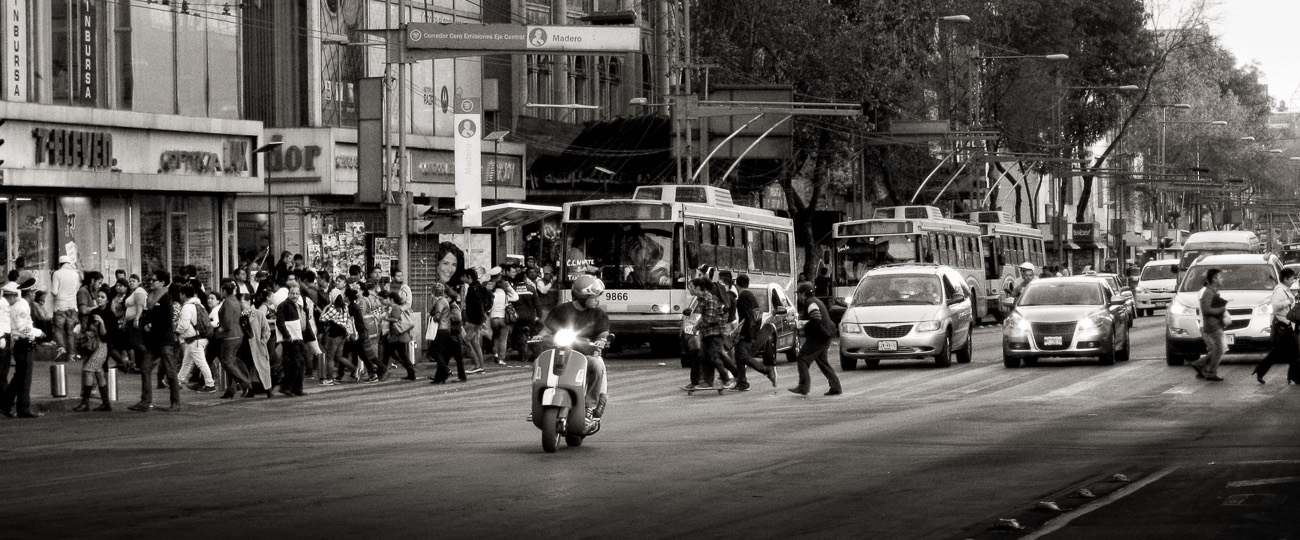
    Mexico City trolley line and traffic on Lázaro Cárdenas

    Mexico City always gets a bad rap – crowded, worn, dangerous, polluted – take your choice. The stereotyping gets a little tiring. Yes, Mexico has its problems, but so too does Montreal, or New York, or  for that matter any other city in the world. On a recent trip to Chicago, for example, the daughter of a friend who picked me up at the airport couldn’t help but tell me how many recent killings there had been block by block as we approached her parent’s home. Thanks but no thanks.

    One of the things I like about travel is comparing the places I go to the place I live. I’m especially attuned to public transport and traffic; one I like and the other I don’t. My best traffic avoidance technique is a bike. In Montreal we have an extensive and expanding bike path system, but also serious problems with bike-truck accidents and figuring out how to balance the shared use of roadways and sidewalks. So when I got to Mexico City I had my antennas out.

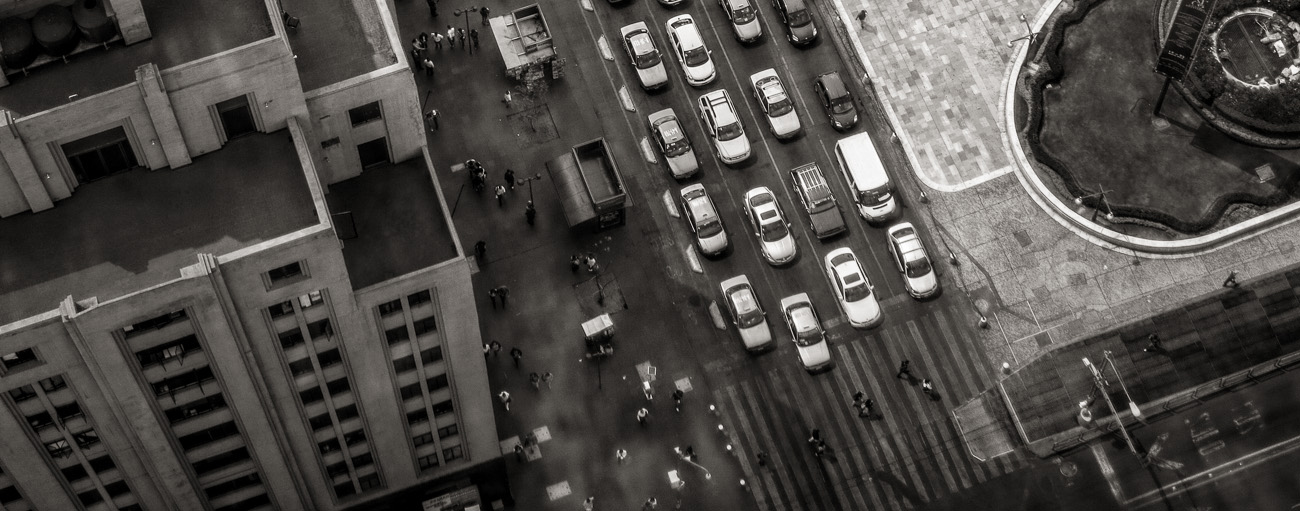
    View of Juárez and Lázaro Cárdenas from Torre Latinoamericana
    Traffic looking down on Juaréz from the Tower Latinoamericana

    We travelled by taxi from the airport and the right away the experience seemed like an invitation to take public transit. In Montreal we talk about using different forms of transport but in Mexico City it’s being done. Their systems handle a lot of people, often with creative solutions to difficult problems. An example would be extending the popular Metrobús system through the narrow streets of the Centro Histórico.

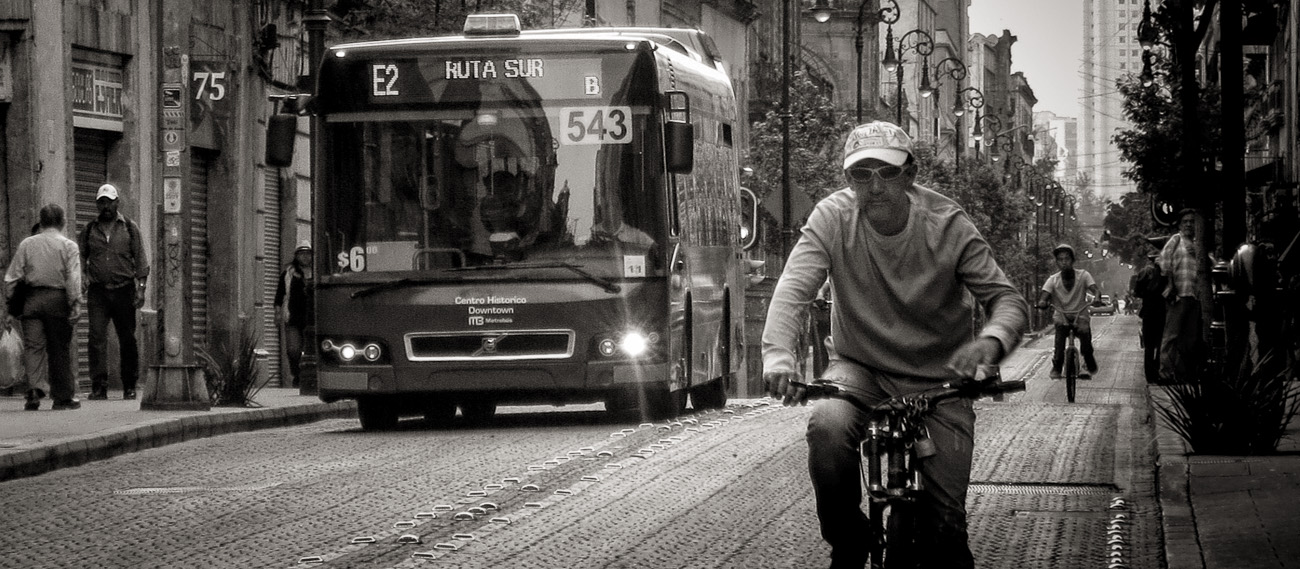
    Metrobús line through Centro Histórico - notice bikes
    Narrow lane Metrobús line through Centro Histórico – notice bikes using other lane

    Mexico City is the third largest city in the world – and the metro system carries 4.4 million people a day (2012), versus the Montreal metro system’s .975 million (2013) people per day  – that’s roughly four and a half  times more volume per day, ranking  it eighth in the world.

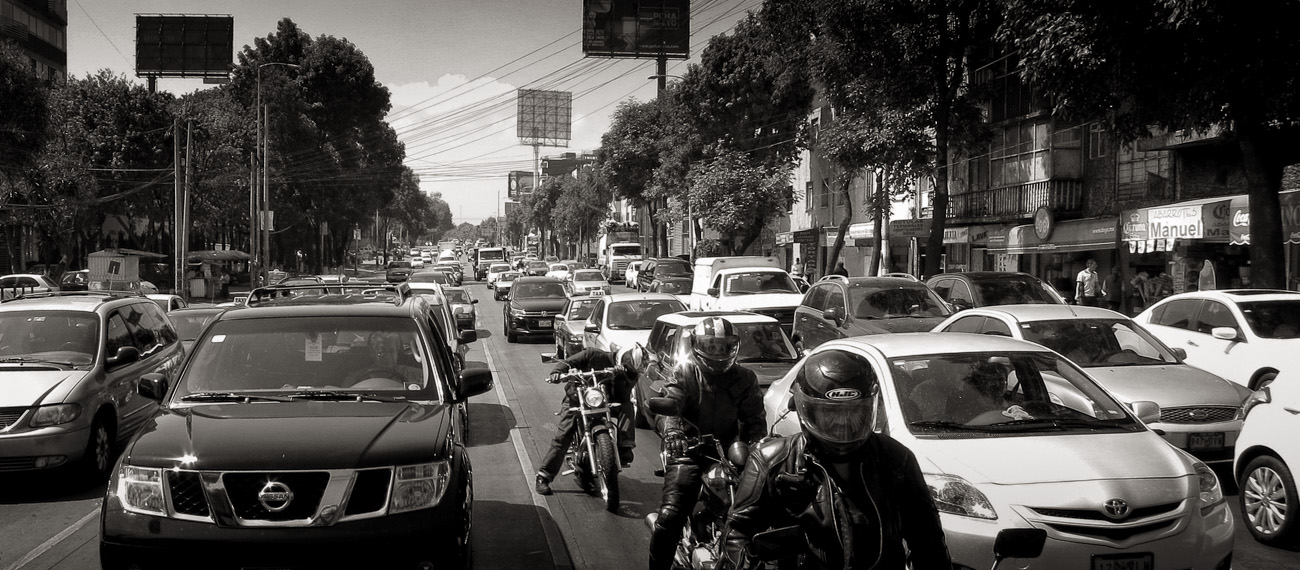
    The only time this street quiets is on holidays or late at night
    Main artery traffic: The only time this street quiets is on holidays or late at night

    The main avenues are rivers of traffic. They start flowing as soon as the light turns green and run fast until the next red. On the main arteries merges are not anything that can be called polite. The protocol is to barge in and whoever is chicken ends up last.

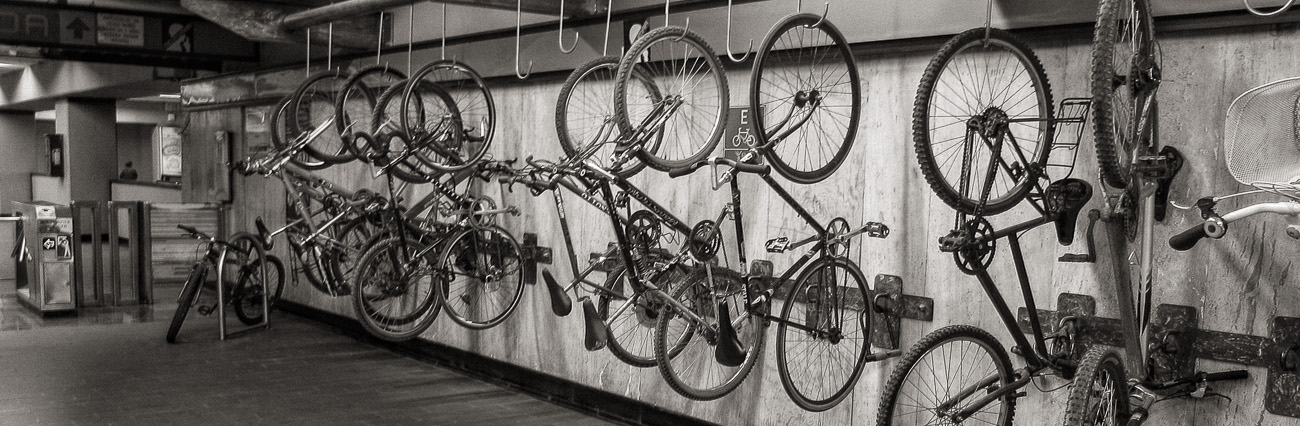
    Locked personally owned bikes near Tacubaya turnstiles
    Not for the weak: Locked personally owned bikes near Tacubaya turnstiles

    It’s that same vehicular aggressiveness that makes it hard to believe that biking in the city would have a happy ending. To be honest, my first reaction was that biking was out in Mexico City. That was my first impression. But I always watch people on bikes trying to gauge what it would be like to be one myself. I saw hopeful signs. Some riders had their own bikes but a lot of people were using bikes from the ecobici rental system. After exploring around on foot I found easy (and used) ways through neighborhoods that avoided the main arteries. I also found well constructed bike paths.

    Next post: bikes in the city