Category: Photography

  • A 23-year streak, broken

    Exceptionalism exists in Canada too

    Last weekend I was at a friend’s party in Montreal and sitting next to a man I had never met. It was noisy, a lot of people speaking excitedly and simultaneously, so the man leaned over towards me and asked me my name. I told him and he looked me straight in the eyes with narrowed pupils while still leaning forward, and let loose The Question: “what kind of a name is that”? I almost fell off my chair. I’ve been living in Canada now for twenty three years and I’ve never been asked that question. When I lived in the United States it was common follow-on to an introduction, but not here. He seemed kindly enough so I explained that my father was Syrian blah blah blah but I was pretty shocked, and I was (and I am) sorry that my multi-decade string of non-exceptionalist Canadian behavior has ended.
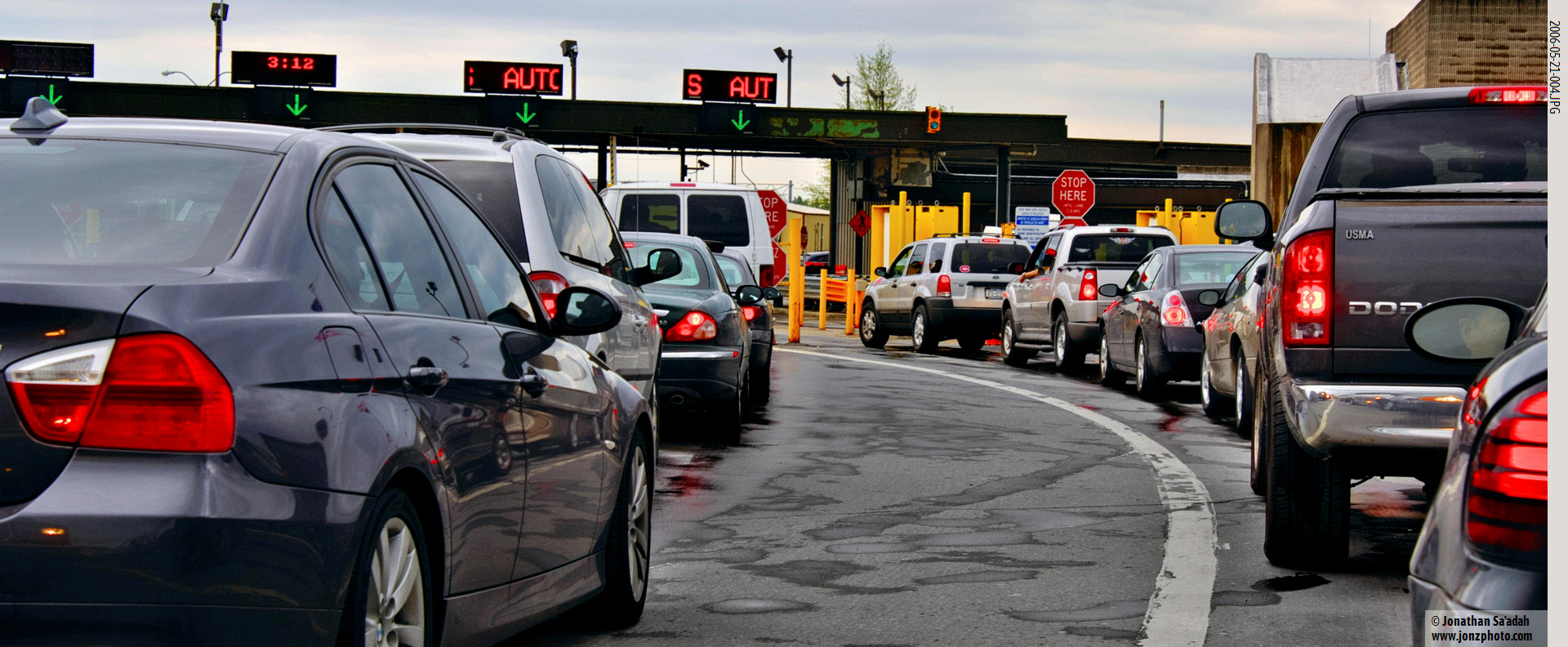
    Canadian-US border crossing in different times.

    Crossing the border

    Yesterday my wife drove down to the Canadian/US border. We hadn’t gone across it since the new US president’s inauguration but she needed to have a paper notarized. Faced with the choice of either driving to Ottawa (183km) and presenting herself at the US embassy (50USD fee) or going across the border (100km) to the always-friendly town clerk in Champlain NY (∅USD), it was a no-brainer.

    She found the main border crossing a desolate place, not a single other car waiting. There’s been a lot of talk in Canada about phones being searched and hostile border control guards, but she had no problem entering the US. Returning to Canada she was asked to roll down her back window and given a one-over, so it’s pretty obvious that Canada is not encouraging its citizens to enter the US. And why should it? Things have happened quickly since January 6, on both sides of the border, and a lot has changed.

    A different view

    As a dual Canadian-US citizen I get to see things from an unusual vantage point, having lived in the US until I was fifty, and then having lived more than two decades in Quebec. It’s only been during the Vietnam War, and now more recently, when some few Americans have looked seriously to Canada as an alternative place. We left earlier than the current wave, but for similar reasons – we saw what was coming, and thought that the move north to a saner country would be a good idea – even if we didn’t know quite what we were getting into.
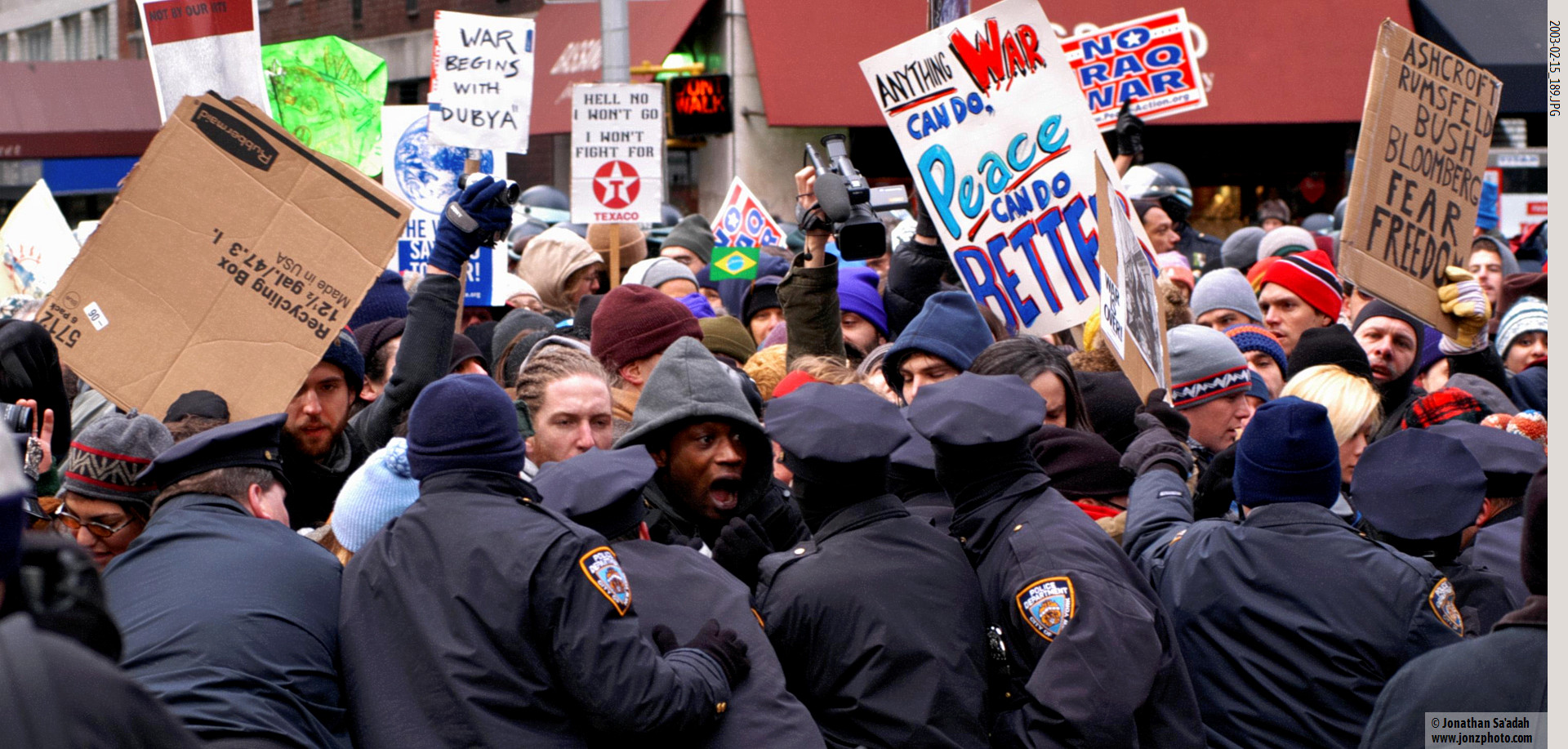
    The lead-in to the second Iraq war, New York City demonstration February 2003. The names change, but the issues remain.

    The federal election this week, where Mark Carney was elected the new Canadian Prime Minister, has capped a rude Canadian awakening to the dangers of sharing a border with a rogue elephant of a state. It’s been a revealing election. Nothing has done more to make me feel Canadian than this period, and the election results reinforced our choice (though we were pretty blind) in making Quebec our home province. The election vote stripped away the weepy rhetoric that often prevails in Quebec, and what was revealed was a province that supported Carney and the Liberal government (43%) versus the American-Elon-Musk inspired Conservative party of Pierre Poilievre (23.4%) by a margin not even closely matched in any of the other provinces. In December of last year you would have been hard pressed to find anyone in the province who would call themselves a Liberal. That’s an exaggeration, but not much. So it’s been quite a change. I don’t see Carney quite as positively as I’d like to, but I was still pleased.

    Prior to Trump II many Canadians possessed a romantically foggy view when looking south. So the last few months have been like the breakup of a formerly “idyllic” marriage: first disbelief, then anger. Trump’s ascendancy this time has only been lightly garbed in reality show politics. His second ascent represents an amplified and aggressively threatening continuation of the bullying conservatism that, over the years, has shown its face in many guises – from the blatant McCarthyism of the Forties and Fifties, through the filth and duplicity of Nixon, morphing into the smoothly front-facing corporate faces of Reagan and the Bush family. That’s not even getting into the Democratic side, which has had its share of failings too. The toxicity has always been around, either in the foreground or just below the surface. The difference now is that it’s fully out and fully vengeful, with a clear road map driving its behavior. Whether Trump II will “succeed” in its destructive course is no longer in question, the damage has already been widespread and generational in scope. The question for us in Canada is how to minimize its effect while steering a way through the geo-political/economic storm. Even if the US courts reign in the Executive branch, and Congress reasserts itself instead of playing dead, trust has been broken. Canada has largely been able to avoid the militarization of society and social breakdown that’s been happening in the United States for decades. However, even though the economic consequences of tariffs have been enough to dramatically accelerate political change here, dealing with them is nothing compared to prospect of having to deal with an increasingly aggressive and politically fragmented country thrashing around to the south. That’s the scary prospect. Let’s hope a path can be found, both internally in the US as well as for us and others.
  • All roads? Perhaps not …

    I’ve never been totally comfortable with Rome. To be honest, I’ve always had problems with authority and authority figures, and there’s no city more populated with both than the old Roman capital. And that’s not even saying anything about the Vatican. I can be relatively sure that my ancestors paid a price to the Romans, and it makes the hair on the back of my neck stand on end when I walk down the present-day beautiful and elegantly-appointed streets and see the wealth and power that’s the product of that price.

    On the other hand, the world has moved on, and I have too. I’ve always been attracted to temperate zone cultures, and Italy is no exception. But all my previous experiences were in the northern tier of the country, especially in the Veneto (Padua, Vicenza, Venice).

    So Rome was a new experience for me. I’ve posted a ⊕portfolio of photographs of the city. The old part of Rome is really set up to be a tourist magnet. As such, it certainly doesn’t let one down. There is a casual, un-curated feeling that makes being there a pleasure. Overlaying the old is the modern jumble of chaos that passes for Italy, complete with savory and unsavory overtones. I am always trying to scratch under the surface and see what I find, and I found a lot.  I have no blood history with Italy but it’s easy to see the racism, the governmental chaos, and excesses along with the society’s appreciation for living life and the long and real investments in art and culture. In short, it’s a fun place to be as a person and a photographer who doesn’t have to live there, and has the privilege of being able to dip in and out.


  • Who said you have to smile for photos?

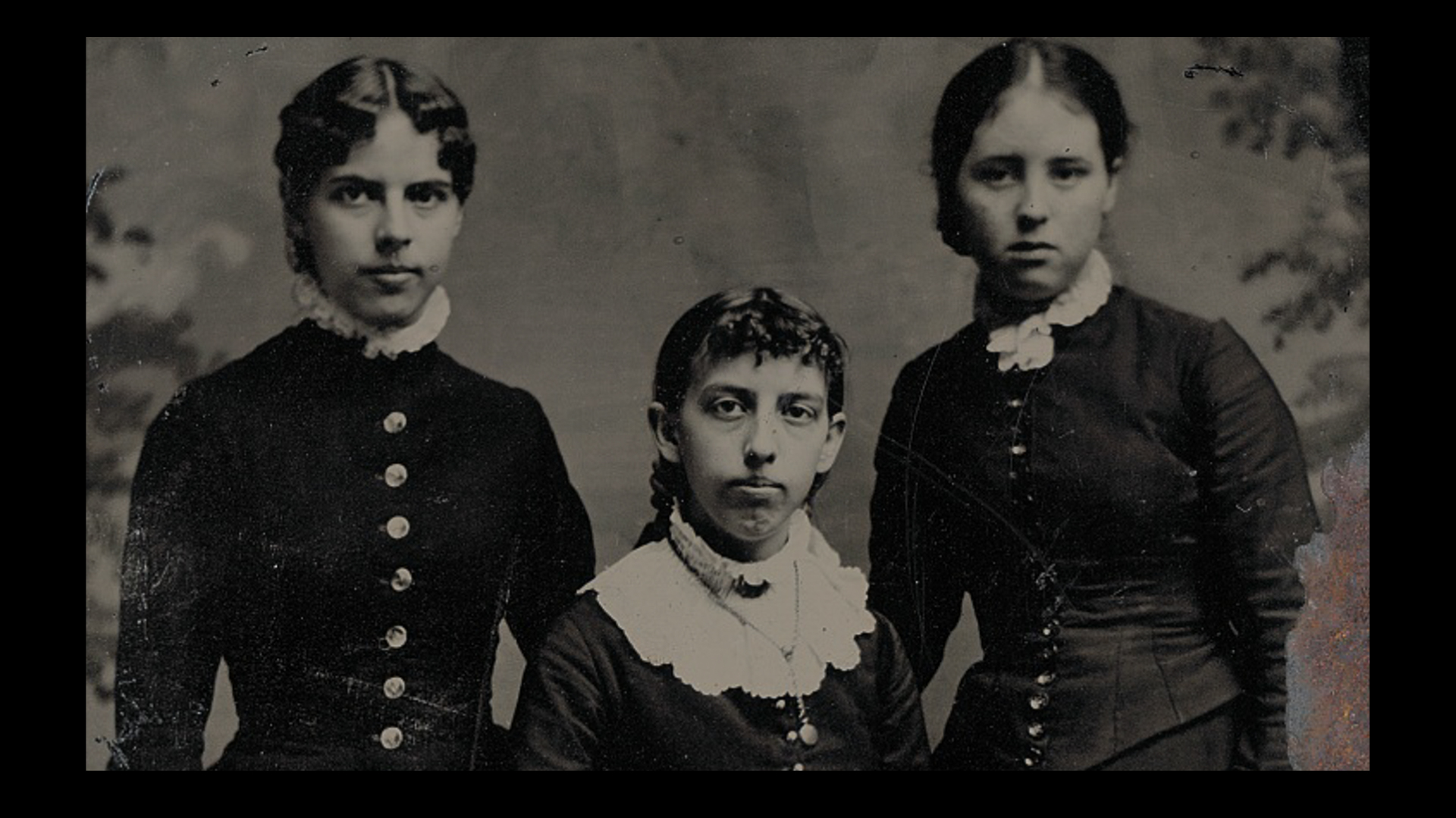
    Not a smile to be seen anywhere  Three sisters, about 1885. Cropped tintype from US Library of Congress.

    Lena Dunham (of the TV show Girls fame) has been having a public spat with a Spanish magazine, accusing the publishers of using Photoshop to improve her thigh. Usually, being “improved” is something people like. Objecting is a twist. Dunham says her problem is the result of a recent change that leaves her against the retouching of photos – even to her benefit. Never one to miss good dialogue, she put it crisply: “I want to be able to pick my own thigh out of a lineup.”

    From a personal point of view, I smell a publicity stunt – she’s a master of that sort of thing. But a large part of me hopes that she’s actually being honest.

    I’ve photographed people a lot and I know that everyone has some part of their body that they’d rather be without – or at least not reminded of. For me it’s the back of my head. For others their nose, their chin.

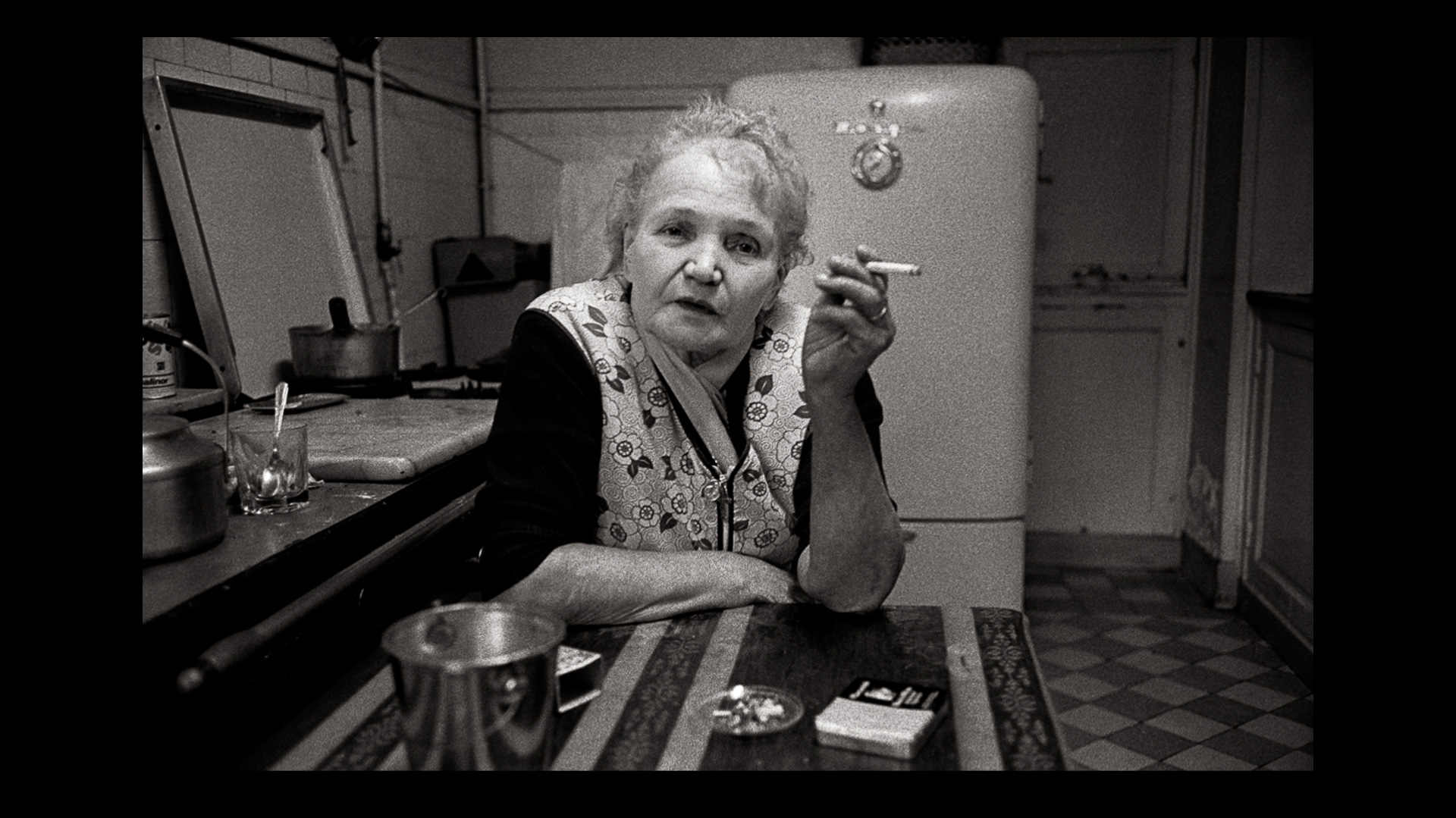
    Catherine Natoli, rue Gruze, Paris, 1976.

    The way this insecurity often manifests itself is in heavy breathing that ensues after a photo portrait. I’m not surprised about it, it seems normal. The common refrain goes like this: “It isn’t that the photos are bad, I just can’t stand the way my [fill in the blank] looks.”

    Beth Adams, Montreal, 2016.

    This insecurity seems almost an universal attribute, at least in our culture. Probably, as a photographer, the kindest approach would be to sit down and interview each person about to be photographed. Usually there’s an unstated tension around portraiture, and it would be easier (and kinder) to have it out in the open. But it’s not like I haven’t experimented. I have one close friend who’s always complained about the way she looked in my photos. Finally, out of some frustration, I let her determine all the variables. What she wanted was a Vogue-style experience, complete with fancy makeup and hair, rim lighting, and styled clothes. I did it. She liked it – I didn’t.

    Joseph Losey, Hanover, New Hampshire, 1971.

    I’ve always been attracted to portraits that say something about the person. It can be a relatively unadorned physical representation of that person – how they looked in a specific period of time in their lives – or it can dig deeper down. I like both. It’s not that I want to make people look bad, and I hope I don’t do that. That’s not my intention, of course, it’s just that I think being human means a lot besides a smiley face.

    So I do want to applaud Lena Dunham. She’s a good enough artist and show-person that I’m sure she’ll be in the public eye for a long time, and it will be interesting to see if she adheres to her current position. But for now, she seems on the right track. I will be following her and hope her new-found conversion will include pictures with more than a pretty smile.

  • Blending in while sticking out

    I think of myself as having grown up in Vermont, but there was a stint of four years when I also lived in Wallingford, Connecticut. It was the Sixties and Wallingford was a gritty industrial town outside of New Haven. It was home to a lot of Italians and also a big silver company. By the time my parents moved there the silver company was gone, and the Italians were not. What was left was a polluted lake with condoms floating in it, and a poor town with a very rich prep school where my father taught.

    Not far outside Wallingford is a town called New Britain. A guy who taught me a lot about photography came from there, where he grew up drag racing Cameros and working on being as offensive to his family as he could be. It was understandable, really. He had gotten drafted into the army and sent to Vietnam, and in the process had developed a severe case of sarcasm and disrespect for the American government, which spilled over into a distaste for his waspy family. He associated his parents with the war, and considering how they had brought him up it probably was not an unfair attitude. In any case, he had gone to Rochester Institute of Technology and was an excellent, if somewhat demented, photographer and he was generous enough to teach me a lot about the craft of printmaking.

    Girls in Monte Carlo SS just north of Hartford, CT (1996)
    Girls in Monte Carlo SS just north of Hartford, CT (1996)

    One of the things that got me about him was always how close he was to physical conflict with people. He spouted loud anti-Semitic views at me, probably figuring that I wouldn’t mind but forgetting I was one of those too. His family was well off, but he had been hurt by the Vietnam experience and you could tell it – his eyes didn’t quite line up and he had a nasty anger that came out, especially when he was stoned – which was often. To him everything was Spics, Jews, Wops and Rag Heads, and all of them were after a part of the country that he owned. Or at least he felt that his family had owned until he got screwed by the government.

    In any case, he was five or ten years older than I was and I kept my mouth shut mostly until the end, when (many years later) we got in a big fight over some comments about Rag Heads and that wrapped things up. But one of the lessons I learned, besides photographic printing, was that in order to get along I needed to suppress what ever ethnic background I felt was mine and pretend (as best I could!) that I too grew up drag racing Cameros on the Berlin Turnpike. I hadn’t, though and it always felt a bit off. I had a slant-six Dodge Dart which was a durable and practical car but not exactly on the sporty side.

    I spent this morning in the basement of a big hospital getting scanned. I find that Canada is quite different in that there’s a lot of noise about privacy but when you’re in a situation like that you’re thrown in much closer with people who have cancer and other really significant diseases and the doors aren’t closed – you are quite aware of what’s going on around you. So when I had a break of several hours I went to visit a couple of good friends near the hospital and have breakfast with them. They have just adopted a child who brought me dolls and animals and then her pottie, all in a friendly effort which included hugs and even a kiss, which were new for me from her. My friends had adopted her a few months ago, and she came from far away, bringing with her who knows what traumas that were part of her almost four year old history. So looking at her dark, round face as she happily munched on part of a croissant across from me made me feel good, and certainly contrasted with the other end of the day.

    My friends are not unusual for Montrealers. In our neighbourhood you see quite a few couples, as well as their children, who are racially and ethnically contrasting. I’m always surprised at how good this makes me feel, and so it’s probably no surprise that when Justin Trudeau was elected and made his announcement about welcoming Syrian refugees it was to some degree solace for the trauma of living through years of the Harper government here, and ethnic jokes and tension in the US.

    I like going to Mexico and being in the culture there. I feel a certain bond with the people, even it’s just one sided. I don’t fit in wiht my Syrian and Armenian blood. But until coming to Canada I was used to being in a Rag Head minority, and I think that Mexicans are used to getting constantly judged. Not only in North America, but unfortunately even in their own country where a lot of social position revolves around skin color.

    Street scene, Good Friday, Iztapalapa (2015)
    People on the street, Iztapalapa (2015)

  • Photography will never be the same

    Selfie trio, þingvellir, Iceland (2015)
    Selfie trio, þingvellir, Iceland (2015)

    Over the last ten years it’s been hard not to be stunned by what’s happened to photography. Near my home is a billboard that’s pretty much owned by Apple. Recently it’s often been showing a simple black and white photo, credited to the current iPhone.

    To say that the smart phone market has shaken up traditional camera manufacturers would be an understatement. Consumers who used to lust after SLRs or fancy point-and-shoots have fallen in with another bedfellow, one that not only takes good photos but also handles email, social media, and makes phone calls.

    I appreciate the smart phone – it’s a remarkable piece of technology. In terms of its camera, even a mid-range phone has some capabilities that high end professional cameras lack. With research and patents funded by a huge market, smart phones are advancing quickly, creating a new sort of pocket camera capable of miraculous exploits.

    And in case you’re wondering, I’m not being facetious.

    There’s been a lot of angst in the photo industry, and it’s no surprise. Dumb companies like Kodak have gone from being enormous cash cows to receivership (and back, in the case of Kodak). Others have faked results, and still others are struggling to redefine themselves in a market that changes from quarter to quarter. Competition among smart phone designers, funded by lavish r&d budgets, pushes rapid advances in hardware and software. It seems pretty safe to say that not only has the photo industry permanently changed, but also that in short order there will be fewer companies selling dedicated, single function cameras.

    Where this all leads is an interesting question. A phone camera, with its pea-sized lens fronting a miniature sensor, is pretty much the definition of convenience and portability for almost everyone. What could be better than this pocketable, sexy small object?

    But hidden in the glitz are a few weaknesses too. Small size is an advantage, but a problem too. Though high-powered brains are competing to improve the smart phone’s miniature lens and small sensor with each generation, the photos they produce still lag behind their larger brothers. Not only that but the photo industry has woken up to an existential battle and now, finally, it’s working hard to improve. Stay tuned, what’s going to happen is anyone’s guess.